
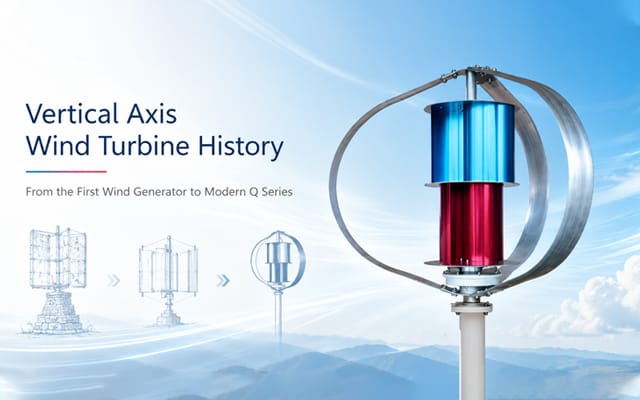
The history of wind power is much older than modern wind farms. Long before today’s large wind turbines appeared on hills, coastlines, and offshore platforms, people were already using wind to grind grain, pump water, and support daily life.
When people search for vertical axis wind turbine history, they often want to know one thing first: what was the world’s first vertical axis wind turbine?
The answer depends on how we define “wind turbine.” If we mean a wind-powered machine with a vertical shaft, the story goes back more than a thousand years. If we mean a wind turbine used to generate electricity, the story leads us to Scottish engineer James Blyth in the late 19th century.
Today, vertical axis wind turbines have moved far beyond early cloth sails and wooden structures. Modern VAWT designs use stronger materials, improved generators, electromagnetic braking systems, and quieter operation. This article explores that journey, from ancient vertical wind machines to modern Q Series Vertical Axis Wind Turbine solutions for homes, farms, rooftops, and off-grid power systems.
Early Vertical Axis Wind Machines Before Electricity
The earliest vertical axis wind machines were not built to generate electricity. They were built to solve practical problems.
Historical records often trace early vertical-axis windmills to regions such as ancient Persia, Iran, and Afghanistan. These machines used vertical shafts and cloth or reed-covered sails to catch the wind. Instead of producing electric power, they were mainly used for milling grain and pumping water.
This is an important distinction.
Those early machines were vertical-axis wind energy devices, but they were not modern wind turbines in the electrical sense. They converted wind into mechanical motion. That motion could turn millstones or move water, helping communities use natural wind resources for daily work.
However, the basic idea was already clear: wind could rotate a vertical shaft and produce useful energy.
That same concept still exists in modern vertical axis wind turbines. The materials, generator systems, blade shapes, and control technology have changed, but the core principle remains connected to those early designs.
James Blyth and the First Wind Turbine Used for Electricity
The next major milestone in vertical axis wind turbine history came in 1887.
Scottish engineer James Blyth built one of the earliest recorded wind turbines used to generate electricity. His machine used cloth sails and a vertical-axis structure with a large rotor. It produced electricity to charge accumulators, which were early batteries, and supplied lighting for his home.
This was a major step forward.
Before Blyth’s experiment, wind machines were mostly associated with mechanical work. Blyth showed that wind could be used to generate electricity for real daily needs. His system also connected wind power with energy storage, which is still one of the most important topics in renewable energy today.
In many ways, Blyth’s work was far ahead of its time. In the late 19th century, coal was still the dominant energy source. Electricity itself was not yet widely available in many homes. Yet Blyth had already demonstrated a small wind-powered system that could generate, store, and use clean energy locally.
That is why his work is often mentioned when discussing the first wind turbine used for electricity generation.
Was Blyth’s Turbine the Same as Today’s VAWT?
Not exactly.
James Blyth’s early wind turbine was very different from the compact vertical axis wind turbines we see today. It used cloth sails rather than modern aerodynamic blades. Its structure was closer to an experimental windmill than a commercial renewable energy product.
However, it had several ideas that still matter today:
1、 used wind as a local energy source.
2、generated electricity instead of only mechanical power.
3、 worked with battery storage.
4、showed that small-scale wind power could support real electricity needs.
Modern vertical axis wind turbines have improved almost every part of this early concept. They use stronger blade materials, better generator efficiency, more stable control systems, and safer braking protection. They can also be integrated with solar panels, batteries, controllers, and inverters to create complete off-grid or hybrid power systems.
So, while Blyth’s wind turbine was not the same as a modern VAWT, it helped open the door to the idea of wind-powered electricity.
From Savonius to Darrieus: Two Important VAWT Designs
After the early period of wind power generation, vertical axis wind turbines developed in several directions. Two of the most important designs are the Savonius rotor and the Darrieus turbine.
The Savonius rotor was invented by Finnish engineer Sigurd J. Savonius in 1922. It is a drag-type vertical axis wind turbine. A traditional Savonius design often uses curved blades that catch wind pressure and create rotation. This type of turbine is known for simple structure and good starting torque, although its overall efficiency is usually lower than lift-based designs.
The Darrieus turbine was patented by French engineer Georges Darrieus in 1931. It is a lift-type vertical axis wind turbine. Its curved or straight airfoil blades use aerodynamic lift to rotate around a vertical shaft. Darrieus-type turbines can be more efficient, but many traditional designs have lower self-starting ability.
These two designs shaped the way engineers think about VAWT performance.
Savonius designs are often associated with starting torque and simple drag force.
Darrieus designs are associated with aerodynamic lift and higher rotational efficiency.
Modern vertical axis wind turbine designs often try to balance these advantages. They aim for easier starting, stable operation, better safety, lower noise, and better performance in changing wind directions.
Why Vertical Axis Wind Turbines Still Matter Today
Horizontal axis wind turbines dominate large wind farms, especially in open areas with strong and stable wind. However, vertical axis wind turbines still have unique value, especially for small and medium-scale projects.
A vertical axis wind turbine can accept wind from different directions without needing to constantly face the wind like a traditional horizontal-axis turbine. This can be useful in complex wind environments, such as rooftops, farms, mountain areas, islands, and semi-urban locations.
VAWTs also have a compact visual profile. For some residential, commercial, and off-grid projects, appearance and installation flexibility matter. A vertical structure can be easier to integrate into certain locations where a large horizontal-axis rotor may not be suitable.
Another reason VAWTs remain popular is their potential role in hybrid energy systems. In many real-world projects, wind power is not used alone. It is often combined with solar panels, batteries, charge controllers, and inverters. This type of wind-solar hybrid system can help provide more stable energy in areas where sunlight and wind complement each other.
That is why vertical axis wind turbine development is not only a historical topic. It is also part of the modern clean energy conversation.
From Early VAWT Concepts to Modern Q Series Designs
Modern vertical axis wind turbines are built for practical energy needs, not just historical interest. Compared with early cloth-sail wind machines, today’s systems focus on durability, safety, power output, noise control, and project customization.
The Q Series Vertical Axis Wind Turbine is a good example of how VAWT technology has moved from simple wind-driven rotation to complete renewable energy solutions.
The Q Series covers multiple power options, including 500W, 1000W, 2kW, 5kW, and 10kW. This makes it suitable for different project sizes, from small residential energy support to farm, rooftop, island, and off-grid power applications.
Its aluminum alloy body helps improve durability for outdoor installation. The turbine uses a three-phase AC permanent magnet generator or maglev generator, depending on the configuration. It also uses an electromagnetic brake system for protection under strong wind conditions.
Another important feature is noise control. With a noise level below 35dB, the Q Series is suitable for projects where quiet operation matters, such as residential areas, farms, villas, and rooftop installations.
It also supports CE certification and customization. Different projects may require different voltage levels, power ratings, tower designs, brackets, colors, packaging, or complete wind-solar hybrid system configurations. This flexibility is important because wind conditions and power needs are rarely the same from one customer to another.
Key Specifications of Q Series Vertical Axis Wind Turbine
The Q Series is designed for users who need a modern vertical axis wind turbine with flexible configuration options.
Typical model range:
500W
1000W
2kW
5kW
10kW
Main technical features:
Start-up wind speed: 3m/s
Rated wind speed: 14m/s
Survival wind speed: 40m/s
Noise level: below 35dB
Body material: aluminum alloy
Generator: three-phase AC permanent magnet generator / maglev generator
Control system: electromagnetic brake
Yaw mode: automatic windward angle
Lubrication mode: self-lubrication
Working temperature: -40°C to 80°C
Certification: CE
Customization: voltage, power, color, bracket, tower, packaging, and system configuration
These features make the Q Series suitable for modern wind power projects that need more than a single turbine. It can be used as part of a complete renewable energy solution with controllers, inverters, batteries, and solar panels.
What Does Rated Wind Speed Mean?
One common misunderstanding about wind turbines is the difference between start-up wind speed and rated wind speed.
Start-up wind speed means the wind speed at which the turbine can begin rotating. For the Q Series, the start-up wind speed is 3m/s.
Rated wind speed means the wind speed at which the turbine reaches its rated power under stable wind conditions. For the Q Series, the rated wind speed is 14m/s.
This does not mean the turbine only works at 14m/s. It means the turbine reaches its rated power when the wind is stable at that level. In real projects, the actual output will change based on several factors, including local wind speed, tower height, installation location, cable loss, controller configuration, and battery status.
This is why professional system configuration is important.
A 5kW wind turbine, for example, does not produce 5kW every hour in all weather. Its real energy generation depends on the wind resource at the installation site. Before choosing a model, users should evaluate average wind speed, site height, surrounding buildings, terrain, and daily power demand.
Where Can Q Series VAWT Be Used?
The Q Series Vertical Axis Wind Turbine can be used in a wide range of small and medium wind power projects.
For homes, it can help supplement electricity use when local wind conditions are suitable. It can be paired with batteries and solar panels to create a more stable residential energy system.
For farms, it can support lighting, monitoring equipment, water pumps, small appliances, and off-grid power systems. Farms often have more open space than urban areas, which can improve wind access.
For rooftops, the compact vertical-axis structure can be useful when installation space is limited. However, rooftop wind projects should always consider building strength, vibration, safety distance, and local permit rules.
For islands and remote areas, wind power can reduce dependence on diesel generators. When combined with solar power and battery storage, a wind-solar hybrid system can provide cleaner and more independent electricity.
For commercial or rural projects, the 5kW and 10kW options can support larger energy needs. These systems are especially useful when customers need customized voltage, power, and energy storage configurations.
Why Modern VAWT Design Is More Than a Turbine
A successful wind power project is not only about choosing a turbine. It is about matching the right turbine with the right system.
A complete project may include:
Wind turbine
Hybrid controller
Inverter
Battery bank
Solar panels
Tower or bracket
Cables and protection devices
Monitoring and installation support
This is especially important for off-grid projects. When there is no stable utility grid, the turbine must work together with storage and power conversion equipment. If the turbine, controller, inverter, and battery are not matched correctly, the system may not perform as expected.
That is why customization matters.
The Q Series can be configured for different power levels, voltage requirements, and installation scenarios. Whether the project is a home, farm, rooftop, island, or rural off-grid system, the final solution should be designed according to real wind conditions and actual electricity demand.
What We Can Learn from Vertical Axis Wind Turbine History
The history of vertical axis wind turbines shows one clear pattern: wind power has always been about practical energy independence.
Ancient vertical windmills helped people mill grain and pump water.
James Blyth’s early wind turbine showed that wind could generate electricity and charge batteries.
Savonius and Darrieus designs helped engineers understand drag, lift, starting torque, and vertical-axis performance.
Modern Q Series VAWT systems continue this development with stronger materials, quieter operation, electromagnetic braking, CE certification, and flexible customization.
The technology has changed, but the purpose remains similar: to turn natural wind into useful power.
Conclusion: From the First VAWT to Modern Clean Energy Systems
Vertical axis wind turbine history is not just a story about old windmills. It is the story of how people learned to use wind more intelligently.
From ancient vertical-axis wind machines to James Blyth’s early electricity-generating turbine, and from Savonius and Darrieus designs to modern Q Series vertical axis wind turbines, each step helped shape today’s renewable energy solutions.
If you are looking for a modern vertical axis wind turbine for a home, farm, rooftop, island, or off-grid project, the Q Series VAWT offers multiple power options from 500W to 10kW, below 35dB noise level, CE certification, and flexible customization for different voltage and system requirements.
For the best result, choose your wind turbine based on local wind speed, installation height, power demand, and whether you need a complete wind-solar hybrid system.
Explore the Q Series Vertical Axis Wind Turbine product page to find a suitable model for your project, or contact the ELEGE team for a customized wind power solution.
FAQ
Who invented the first vertical axis wind turbine?
If we talk about early vertical-axis wind machines, the history goes back to ancient windmills used in regions such as Persia, Iran, and Afghanistan. If we talk about electricity generation, James Blyth’s 1887 wind turbine is one of the earliest recorded wind turbines used to generate electricity.
What is the difference between early vertical windmills and modern VAWTs?
Early vertical windmills mainly produced mechanical power for milling grain or pumping water. Modern vertical axis wind turbines generate electricity and can work with controllers, inverters, batteries, and solar panels.
Is a vertical axis wind turbine suitable for home use?
Yes, a vertical axis wind turbine can be suitable for home use if the local wind resource is strong enough and the installation site is appropriate. It is often used with batteries or solar panels for better energy stability.
What does rated wind speed mean?
Rated wind speed is the wind speed at which the turbine reaches its rated power under stable wind conditions. It is different from start-up wind speed, which is the wind speed needed for the turbine to begin rotating.
Why choose the Q Series Vertical Axis Wind Turbine?
The Q Series offers 500W to 10kW options, below 35dB noise level, aluminum alloy structure, electromagnetic brake control, CE certification, and flexible customization. It is suitable for homes, farms, rooftops, islands, and off-grid wind-solar hybrid systems.