
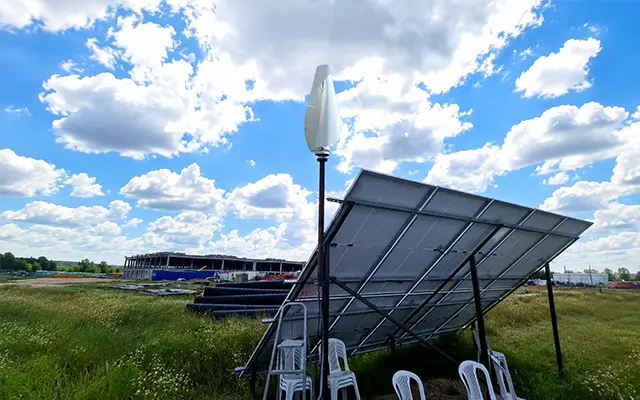
Many buyers ask a simple question before choosing a turbine: how fast do small wind turbines spin?
The answer is not a fixed number. A small wind turbine changes speed as the wind changes. Blade size, wind speed, generator load, and controller settings all affect RPM.
For the ELEGE EV vertical axis wind turbine, the rated rotation speed is usually 150–200 RPM. This range can also be customized based on the model and project needs.
But speed is not everything. A good small wind turbine should start easily, run quietly, control speed safely, and produce stable power.
What Does RPM Mean for a Wind Turbine?
RPM means revolutions per minute. It shows how many full turns the rotor makes in one minute.
For example, if a turbine turns 150 times in one minute, its speed is 150 RPM.
Small wind turbine RPM is not always the same. In light wind, the turbine turns slowly. In stronger wind, it turns faster. When the controller starts braking, the speed drops again.
This is why RPM should not be the only number you check.
Do Small Wind Turbines Spin Faster Than Large Wind Turbines?
In many cases, yes. Small wind turbines often spin faster because their blades are shorter.
Large wind turbines look slow, but their blades are very long. The blade tips can still move very fast, even when the rotor turns slowly.
Small turbines have shorter blades, so they may need higher RPM to reach their working range.
Still, faster does not always mean better. A turbine that spins too fast can create more noise, vibration, heat, and mechanical stress.
Does Faster Spinning Mean More Power?
No. Faster spinning does not always mean more electricity.
Real wind turbine output depends on wind speed, blade design, generator efficiency, controller matching, and system load.
A turbine needs enough speed to generate power. But too much speed can reduce comfort and shorten service life if the system is not controlled well.
For small wind power systems, stable operation is usually more important than extreme RPM.
Start-Up Wind Speed vs. Cut-In Wind Speed
These two terms are easy to confuse.
Start-up wind speed means the wind speed needed to make the turbine begin rotating.
Cut-in wind speed means the turbine starts producing usable electricity.
The ELEGE EV series can start rotating from 1.3 m/s. Its cut-in wind speed is 3.5 m/s.
This means the turbine may begin moving in light wind, but it needs stronger wind to produce usable power.
The rated wind speed is usually 10–11 m/s, depending on the model. This is the wind speed needed for rated power output.
How ELEGE EV Turbines Balance Speed, Noise, and Safety
The ELEGE EV vertical axis wind turbine is designed for small wind power systems that need stable speed and quiet operation.
Its rated rotation speed is usually 150–200 RPM. This is not an extreme speed range. That is the point.
For many small wind projects, controlled rotation is better than uncontrolled high speed. It helps reduce noise, vibration, and mechanical stress.
The EV series uses a coreless 3-phase AC generator. This helps reduce starting resistance and supports smoother rotation.
It also uses an electromagnetic control system and controller automatic braking. When wind becomes too strong, the controller helps slow down the turbine.
The EV series is designed for low-noise operation below 40 dB under suitable operating conditions. This is useful for projects where quiet operation matters.
ELEGE EV Series Key Specifications
| Specification | ELEGE EV Series |
|---|---|
| Power Options | 500W, 1000W, 1500W, 2000W, 3000W, 5000W |
| Rated Rotation Speed | 150–200 RPM, customizable |
| Start-Up Wind Speed | 1.3 m/s |
| Cut-In Wind Speed | 3.5 m/s |
| Rated Wind Speed | 10–11 m/s, depending on model |
| Noise Level | Below 40 dB under suitable operating conditions |
| Generator | Coreless 3-phase AC generator |
| Control System | Electromagnetic control |
| Safety Protection | Controller automatic braking |
| Material | Glass / basalt fiber |
| Lubrication Mode | Self-lubrication |
| Working Temperature | -40°C to +80°C |
What Happens If a Wind Turbine Spins Too Fast?
If a wind turbine spins too fast, noise usually increases first.
Then vibration, heat, and mechanical stress may also increase. Over time, this can affect the blades, bearings, and generator.
This is why a small wind turbine needs speed control.
The ELEGE EV series uses controller automatic braking. This helps keep the turbine within a safer working range during strong wind or over-speed conditions.
Vertical Axis Wind Turbine or Horizontal Axis Wind Turbine?
A horizontal axis wind turbine usually needs to face the wind direction. It often works well in open areas with stable wind.
A vertical axis wind turbine can capture wind from different directions. This is useful when wind direction changes often.
For small wind applications, the best choice is not always the fastest turbine.
If your site has changing wind direction, limited space, or low-noise requirements, a vertical axis wind turbine may be more practical.
How to Choose the Right Small Wind Turbine
Do not choose a small wind turbine only by RPM.
Start with your site conditions. Check the wind speed, installation height, nearby obstacles, power demand, and system design.
Before choosing a turbine, consider these points:
- Average wind speed at the site
- Installation height
- Nearby trees, walls, or buildings
- Noise requirements
- Battery and inverter matching
- Controller braking protection
If the wind direction changes often, the ELEGE EV vertical axis wind turbine can be a practical option.
If the turbine will work with solar panels, batteries, or an inverter, the full system must be matched correctly.
Conclusion
How fast do small wind turbines spin? The answer depends on wind speed, blade design, generator load, and controller settings.
The ELEGE EV vertical axis wind turbine usually works at 150–200 RPM. It can start rotating from 1.3 m/s and starts producing usable electricity at 3.5 m/s.
It also uses controller automatic braking for speed protection and is designed for low-noise operation below 40 dB under suitable conditions.
For small wind power users, the better turbine is not the one that only spins faster. It is the one that starts easily, runs quietly, controls speed safely, and produces stable power.
FAQ
How fast do small wind turbines spin?
Small wind turbines spin at different speeds depending on wind speed, rotor size, blade design, generator load, and controller settings. The ELEGE EV series usually operates at 150–200 RPM.
Does faster spinning mean more electricity?
Not always. Power output depends on wind speed, blade efficiency, generator design, controller matching, and system load.
What is the start-up wind speed of the ELEGE EV turbine?
The start-up wind speed is 1.3 m/s. This means the turbine can begin rotating in light wind.
What is the cut-in wind speed of the ELEGE EV series?
The cut-in wind speed is 3.5 m/s. This means the turbine starts producing usable electricity when the wind becomes stronger.
Is the ELEGE EV wind turbine quiet?
Yes. The EV series is designed for low-noise operation below 40 dB under suitable operating conditions.
How does the ELEGE EV turbine control speed?
The EV series uses controller automatic braking. This helps protect the turbine during strong wind or over-speed conditions.