
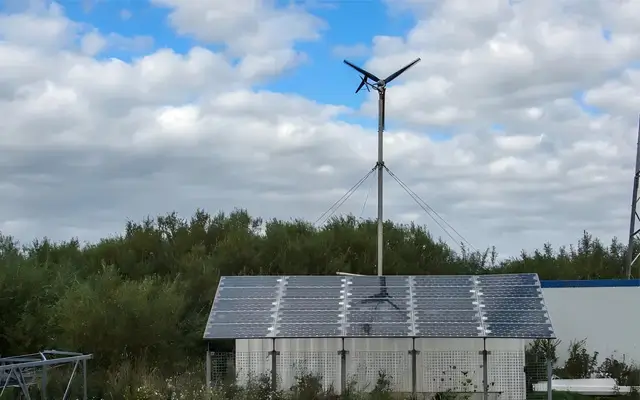
Maximizing ROI: How Hybrid Wind-Solar Systems Drastically Reduce Operational Costs
In remote locations, telecommunications sites, and off-grid industrial facilities, energy supply is often the heaviest burden on the operational budget. For decades, diesel generators were the default solution, but volatile fuel prices, expensive logistics, and grueling maintenance schedules have forced a shift toward more efficient alternatives.
Hybrid Wind-Solar systems—which integrate wind turbines with solar photovoltaic (PV) panels—are emerging as the gold standard for slashing Operating Expenditures (OPEX). By leveraging the natural synergy between wind and sun, these systems provide more than just green energy; they offer a sophisticated strategy for long-term cost reduction.
1. The Power of Synergy: Beyond Single-Source Energy
A hybrid system is not merely a collection of hardware; it is a strategic balancing act that optimizes energy production curves through natural resource complementarity.
Diurnal Complementarity: Lowering Storage Costs
Solar energy peaks during daylight hours, while wind energy is often most active at night or during stormy weather. This natural “relay” allows the system to generate power 24/7. Compared to a solar-only setup, a hybrid system reduces the need for massive battery banks. While a solar-only site might require 3–4 days of autonomy to survive cloudy periods, a hybrid system can often achieve the same reliability with only 1–2 days of storage, significantly lowering initial hardware investment.
Slashing Fuel and Logistics Expenses
For sites reliant on diesel, the true cost of fuel isn’t just the market price—it includes the “last-mile” delivery. In rugged or remote terrain, transporting fuel can double or triple the cost per liter. A well-sized hybrid system can displace 80% to 90% of fuel consumption, relegating the generator to an emergency backup role and saving thousands in fuel and transport logistics annually.
Extending Asset Lifespan
- Generator Longevity: Generators running 24/7 require monthly servicing and frequent overhauls. In a hybrid setup, the generator runs only during extreme gaps in renewable production, extending its service life from 2 years to over 10 years.
- Battery Health: Because wind and solar charge the system at different times, batteries avoid the deep, frequent discharge cycles that kill them prematurely. This smoother cycling extends battery life and delays the expensive replacement phase.
2. Economic Comparison: LCOE and Payback Periods
When evaluated by the Levelized Cost of Energy (LCOE), hybrid systems demonstrate superior long-term competitiveness compared to traditional or single-source methods.
| Cost Factor | Diesel Only | Solar Only | Wind Only | Hybrid Wind-Solar |
|---|---|---|---|---|
| Fuel Costs | High & Volatile | None | None | None |
| Maintenance | Monthly | Annual | Bi-annual | Bi-annual |
| Battery Capacity | Minimal | Large | Large | Medium |
| Capacity Factor | 90%+ | 15–25% | 20–30% | 35–45% |
| Payback Period | N/A | 7–10 Years | 8–12 Years | 5–8 Years |
3. Risk Mitigation and Downtime Prevention
For off-grid operators, the most “invisible” cost is the loss of revenue during downtime. Hybrid systems address this through:
- Redundancy: Built-in energy security. If a wind turbine requires maintenance, the solar panels continue to provide power, and vice versa.
- Simplified Spare Parts: PV panels have no moving parts, and modern small wind turbines are built for long-term durability, reducing the need for extensive onsite mechanical inventories.
4. Conclusion
Hybrid Wind-Solar systems are no longer just a “green” choice—they are a financial one. By utilizing the seasonal and daily complementarity of wind and sun, businesses can achieve a more stable power profile, longer asset life, and a significantly lower total cost of ownership.